
Bipartisan Effort Brings $1 Million to Kane County to Fight Human Trafficking and Child Exploitation
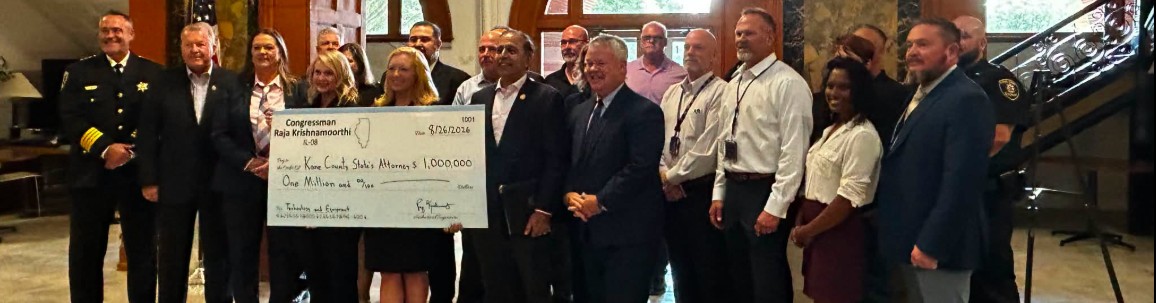
Bipartisanship can deliver meaningful results for our communities, and a recent $1 million federal investment in Kane County is a powerful example. U.S. Rep. Raja Krishnamoorthi secured a $1 million Community Project Funding grant to expand and modernize digital forensics capabilities used by Kane County law enforcement to investigate child exploitation, human trafficking and other serious crimes. It was an honor to join Rep. Krishnamoorthi, Kane County State’s Attorney Jamie Mosser, Sheriff’s Office Undersheriff Amy Johnson and other local leaders Aug. 26 in Geneva to celebrate the investment.
The grant will provide Kane County with advanced technology, specialized equipment and training to securely extract, preserve and analyze digital evidence. As criminals increasingly use smartphones, computers, artificial intelligence and other technologies to exploit vulnerable victims, law enforcement must have the tools to keep pace. The new resources will allow multiple forensic examiners to process and analyze large amounts of digital evidence simultaneously while securely storing and accessing that evidence through a centralized system.
Since the Kane County State’s Attorney’s Office established its Child Exploitation Unit in 2022, authorities have arrested 93 people, executed more than 500 search warrants and conducted digital forensic examinations of more than 750 devices. The county’s Human Exploitation Unit, which works in partnership with the Sheriff’s Office, local law enforcement and federal agencies, has also resulted in seven arrests and more than 79 search warrants.
In addition to strengthening technology, the grant will also help provide enhanced cooperation among Kane County’s more than 30 law enforcement agencies by giving investigators better tools to tackle complex crimes and help ensure justice for victims and their families. The expanded capabilities will also make it easier for agencies to share expertise and coordinate investigations that often cross municipal, county, state and even international boundaries.
This grant is an investment in protecting children, supporting victims and giving law enforcement the resources necessary to identify predators and disrupt human trafficking operations. At a time when technology is changing rapidly and criminals are finding new ways to exploit it, bipartisan investments like this ensure Kane County’s law enforcement agencies are better prepared to protect the most vulnerable members of our communities.
Major Rebuild Illinois Investments Coming to Kane County
 I am pleased to announce that more than $242.5 million in transportation investments are coming to Kane County through five major projects funded by the Rebuild Illinois capital program. As Minority Spokesperson for the Senate Transportation Committee, I have always supported Rebuild Illinois and its focus on addressing Illinois’ long-overdue infrastructure needs. These investments will improve safety and mobility, create good-paying jobs and strengthen the transportation infrastructure our families and businesses depend on every day.
There are five upcoming major projects in the Kane County area, they are scheduled to be completed between 2027-2030.
- Illinois 47 from Jericho Road to south of Galena Road reconstruction. Work is anticipated to begin in summer 2027 and be completed in 2028. One lane of traffic will remain open throughout construction.
- Illinois 47 from Cross Street to Jericho Road reconstruction. Work is anticipated to begin in spring 2027 and be completed in 2028. One lane of traffic will remain open throughout construction.
- Illinois 25 at May Lane, Courier Avenue and Seminary Road intersection improvements, channelization and culvert replacement. Work is anticipated to begin in spring 2027 and be completed in fall 2027. One lane of traffic will remain open throughout construction.
- U.S. 20 at Illinois 31 to east of Grace Street bridge replacement. Work is scheduled to begin in spring 2027 and be completed in 2030. One lane of traffic will remain open throughout construction.
- U.S. 20 west of Randall Road to east of Shales Parkway noise wall construction. Work is anticipated to begin in spring 2027 and be completed in 2028. One lane of traffic will remain open throughout construction.
McHenry County is also slated to receive a large allocation of Rebuild Illinois funds. More than $133 million will be spent on projects outside of the 33rd Senate District and within the neighboring 32nd District.
I am particularly proud that Rebuild Illinois was the result of Republicans and Democrats coming together around a shared priority. Approved in 2019, the $33.2 billion capital program is the largest in Illinois history and represents a truly bipartisan commitment to rebuilding our state. After decades of deferring critical infrastructure projects, we finally have a plan that is making significant investments in roads, bridges and other transportation systems while supporting thousands of good-paying jobs.
The progress is significant. Through Year Seven, Rebuild Illinois has delivered $25.6 billion in improvements statewide, including work on nearly 24,500 miles of highways, 959 bridges and 1,475 additional safety improvements. Here in Kane County, these investments will help address growing traffic demands, improve key economic corridors and ensure our infrastructure keeps pace with the continued growth of our communities.
Illinois demonstrates what is possible when we put partisan differences aside and work together on priorities that benefit everyone. These projects will make our roads safer, our communities more connected and our region better positioned for continued economic growth.
Landmark Meta Settlement Should Deliver Nearly $768 Million to Illinois and Lead to New Protections for Children
A landmark multistate settlement should require Meta, the parent company of Facebook and Instagram, to pay up to $17.1 billion over the next 10 years to resolve allegations that its Facebook and Instagram platforms used addictive features and harmed children, while also forcing the social media giant to implement significant new protections for young users.
Under the proposed agreement, Illinois could receive nearly $768 million over the 10-year settlement period. The financial penalty represents significant accountability for one of the world’s largest social media companies, but the most important part of the settlement is what it could mean for parents and children going forward.
The terms of the settlement state that Illinois’ share is supposed to be used for remedial or restitutive purposes connected to the harms alleged in the lawsuit, and not meant to be absorbed into general revenue spending.
The agreement would require Meta to implement stronger age-assurance measures designed to identify whether users are teenagers or children under 13. Meta would also be required to use technology to identify and remove underage accounts and provide easier ways for users to report accounts believed to belong to children under 13.
Teen users would also receive stronger protections by default. Those safeguards include limits on overnight platform access, daily usage limits, reduced notifications during school hours, prompts encouraging teens to take breaks, stronger privacy and content settings, and additional protections intended to reduce potentially harmful interactions.
Parents would receive additional tools to supervise their children’s accounts, including greater control over time and content restrictions and increased information about their teen’s use of Meta’s platforms.
The settlement also includes accountability measures designed to ensure those protections are actually implemented. An independent auditor would review Meta’s compliance, identify material weaknesses, and oversee corrective actions when necessary.
Legislation Signed into Law Makes it Easier to Get Prescriptions Filled
Illinois patients who arrive at a pharmacy only to find their medication is out of stock will now have an easier time getting their prescriptions filled under newly signed legislation I supported this year.
Senate Bill 3213 expands the types of prescriptions that can be electronically transferred from one pharmacy to another. Previously, Illinois law placed greater restrictions on prescription transfers than federal law, which could leave patients unable to quickly move a prescription when a pharmacy did not have the medication available.
The new law brings Illinois requirements more closely in line with federal standards, making it easier for patients to transfer prescriptions when needed. It also makes it easier for medical professionals to issue prescriptions after hours.
Senate Bill 3213 passed both chambers of the General Assembly unanimously and was signed into law on August 21.
Two More Senior Expos and a Shred Event Round Out Events Calendar for 2027
 Outreach event season is winding down, and this year I offered a comprehensive calendar of events to help people of all ages. Included in my calendar of events this were was a youth advisory council, a prescription drug dropoff event, a mobile DMV event, a property tax exemptions seminar, a youth art contest, multiple IPASS on Demand events, multiple ICASH/Unclaimed property events, and the first of three senior fairs.
Remaining events for the year include:
- September 12: Document Shredding Event and Food Drive in Elgin
- September 15: Senior Fair in St. Charles
- October 14: Senior Fair in Crystal Lake
These events are listed on the Events page of my website with full details.
Registering to Vote
With the general election just around the corner, now is the time for Illinois residents to learn more about the voting process and how to register. Whether you’re a first-time voter or need to update your information, voting is a way to make your voice heard in government.
Voter requirements in Illinois include:
- Being a U.S. citizen
- Living in your election precinct for at least 30 days prior to Election Day
- Being at least 18 years old by the date of the general election
- You must not be serving a sentence of confinement in any penal institution as a result of a conviction.
- You may not claim the right to vote anywhere else.
Voters can register online, in person at the office of the election authority, at a DMV, via mail, or with appointed jurisdiction registrars. Online registration does close at the end of the day on October 18.
For those who need to check their registration status or want to register to vote, visit the Illinois Online Voter Registration Application Website.