
DeWitte Publishes Guest Editorial on Gas Tax Shell Game in Daily Herald
I want to thank the Daily Herald for publishing an opinion piece I recently wrote about the shell game being played by the Pritzker Administration with regard to the gas tax in Illinois. Here is the text of the guest editorial, which was published on Monday, June 15:
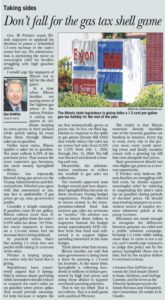
Don’t Fall for the Gas Tax Shell Game
Governor JB Pritzker wants Illinois taxpayers to applaud his decision to pause a scheduled 1.3-cent increase in the state’s motor fuel tax. His administration is portraying the move as meaningful relief for families struggling with high gasoline prices.
I would urge the taxpayers of Illinois not to fall for the shell game.
At a time when Illinois families are paying some of the highest gas prices in the nation, the Governor is asking taxpayers to celebrate keeping an extra penny in their pockets while quietly taking far more from them through Illinois’ sales tax on gasoline.
Unlike most states, Illinois applies a sales tax to gasoline. The state collects 6.25 percent of the purchase price. That means the more expensive gas becomes, the more money Springfield collects.
The Governor has repeatedly blamed rising gas prices on the Trump Administration and federal policies. Whether you agree with that assessment or not, one fact is undeniable: if gas prices go up, state government profits.
Consider a simple example. If gasoline costs $5 per gallon, Illinois collects more than 31 cents per gallon from the state’s 6.25 percent sales tax alone. Yet the Governor wants taxpayers to focus on a 1.3-cent motor fuel tax increase that is being delayed.
In practical terms, that’s like putting 1.3 cents into one pocket while taking 31 cents out of the other.
The Governor is hoping taxpayers notice only the hand that is giving.
Republicans have consistently argued that if Springfield is serious about providing relief, lawmakers should reduce or suspend the state’s sales tax on gasoline when prices spike. That would provide meaningful help because it targets the tax that automatically grows as prices rise. In fact, we filed legislation in response to the spike in gas prices (Senate Bill 4205) that would reduce the sales tax on motor fuel sales from 6.25% to 1.25% from July 1, 2026, through December 31, 2026. The bill was blocked and denied a hearing and vote.
Meanwhile, the administration continues to collect the windfall in gas sales tax collections.
The recently approved state budget reveals just how dependent Springfield has become on these revenues. During budget negotiations, the Governor referred to excess money in the transportation-related fund that receives gas sales tax revenues as “surplus.” His solution was not to return those dollars to taxpayers. Instead, the budget swept approximately $150 million from that fund and redirected it to support higher spending elsewhere in the state budget.
Think about what that means.
Illinois families are told that state government is doing them a favor by pausing a 1.3-cent tax increase. At the same time, Springfield is collecting hundreds of millions of dollars generated by high fuel prices and using those dollars to support unrelated spending priorities.
That is not tax relief. That is not reform. That is a shell game and a political PR move.
The reality is that Illinois motorists already shoulder one of the heaviest gasoline tax burdens in America. Every trip to work, every trip to the grocery store, every youth sporting event and family vacation comes with a growing tax bill that rises alongside fuel prices.
State government should not view higher gas prices as a revenue opportunity.
If the Governor truly believes Illinois families are struggling with fuel costs, he should support meaningful relief by reducing or suspending the state’s sales tax on gasoline during periods of elevated prices. He should stop treating taxpayers as a convenient source of surplus revenue whenever prices at the pump increase.
Illinoisans are smart enough to recognize the difference between genuine tax relief and a public relations campaign. Keeping 1.3 cents while taking more than 31 cents is not a tax cut, and I would urge taxpayers to judge this policy not by the penny Springfield chose not to take, but by the surplus dollars it continues to keep.
Pritzker Signs Record-High Budget Despite Republican Opposition
On June 16, Gov. JB Pritzker signed the Fiscal Year 2027 state budget into law, locking in a record-high $55.9 billion spending plan that continues Illinois’ troubling pattern of higher taxes, increased spending and misplaced priorities.
The budget, which takes effect July 1, was passed by Democratic lawmakers in the early morning hours on the final day of the legislative session. Despite repeated warnings from Senate Republicans about the state’s unsustainable spending habits and the continued burden on Illinois families and employers, the budget advanced without Republican support.
The record-spending budget includes hundreds of millions of dollars in new taxes and revenue increases. Since taking office, Governor Pritzker has grown state spending by 40 percent and has repeatedly relied on tax and fee increases to fund his spending plans. At a time when families are already struggling with rising costs, Senate Republicans argued the state should be focused on real, permanent tax relief rather than creating new revenue streams to support more government spending.
The signing also came after the Governor used his veto powers to eliminate over $500 billion in budgeting errors included in the massive spending plan, further highlighting concerns about the rushed and closed-door process used to push the budget through the General Assembly.
My Senate Republican colleagues and I have consistently called for a more responsible approach to budgeting that prioritizes affordability, economic growth, property tax relief, and long-term stability for Illinois taxpayers. Instead, what taxpayers are left with is more spending, more taxes, and fewer meaningful reforms.
Full Calendar of Events Planned for 33rd District This Summer/Fall
 I want to thank everyone who came out to the ICASH/Unclaimed Property Event I hosted in Carpentersville last week. We had a great turnout and successfully connected several people with unclaimed property/cash.
Our summer and fall events calendar is full of free outreach events for residents of all ages. Please mark your calendar for these additional upcoming events:
- July 13: IPASS on Demand in South Elgin
- August 4: ICASH/Unclaimed Property Event in South Elgin
- August 19: Senior Fair in Carpentersville
- September 12: Document Shredding Event in Elgin
- September 15: Senior Fair in St. Charles
- October 14: Senior Fair in Crystal Lake
All of these events are listed on the Events page of my website with full details. Additional events are added regularly, so please visit my Events page regularly to learn about new events as they are added to the schedule.
Department of Early Childhood set to become fully operational July 1
Beginning July 1, the Illinois Department of Early Childhood is set to become fully operational, marking the next phase in the state’s effort to consolidate early childhood programs and services under one agency.
The department was created in 2024 through Senate Bill 1, also known as the Department of Early Childhood Act. Under the transition, the new department will take over several programs that were previously housed across three separate state agencies: the Illinois State Board of Education, the Illinois Department of Human Services and the Illinois Department of Children and Family Services.
Those responsibilities include the Early Childhood Block Grant at ISBE, which funds Preschool for All and Prevention Initiative programs; the Child Care Assistance Program, home-visiting programs and Early Intervention services currently at IDHS; and day care licensing, which has been managed by DCFS.
The department began operating in a limited capacity in 2024, while existing agencies continued administering programs during the transition. The full transfer of programs is scheduled to take effect with the start of fiscal year 2027 on July 1.
Vistra Announces Closure of Three Illinois Power Plants
A major power company has announced plans to close three Illinois power plants in the coming years, raising new concerns about the future reliability and affordability of the state’s energy grid.
Vistra Corp., one of the largest competitive power generators in the country, recently notified the state of Illinois that it intends to close power plants located in Baldwin, Kincaid, and Newton.
According to media reports, the closures will impact hundreds of Illinois workers. Vistra plans to lay off 83 workers from the Newton plant in October 2027, 99 employees at the Kincaid site in January 2028, and 122 employees in Baldwin in February 2028.
Senate Republicans, who have been sounding the alarm about Illinois’ looming energy crisis under Gov. JB Pritzker’s controversial energy policies, said the announcement is frustrating but not unexpected.
For years, Senate Republicans have warned that the Pritzker Administration’s rush to shut down reliable fossil-fuel power without a realistic replacement plan would threaten jobs, weaken grid reliability and drive up costs for families and businesses.
That future was set in motion when Gov. Pritzker signed the controversial Climate and Equitable Jobs Act (CEJA) in 2021. Under CEJA, Illinois was placed on a government-mandated path to phase out coal and natural gas power generation. However, Gov. Pritzker and Democratic lawmakers have failed to put forward a workable plan to replace the reliable baseload power being forced offline.
The result is now being felt in communities across Illinois. The planned closures in Baldwin, Kincaid and Newton mean lost jobs, reduced local economic activity, and fewer reliable energy resources at a time when electricity demand continues to grow.
Senate Republicans said Illinois needs a balanced energy policy that protects jobs, keeps utility costs affordable and ensures families and employers have access to reliable power.