Release of Benton Report Highlights Need for Ethics Reforms
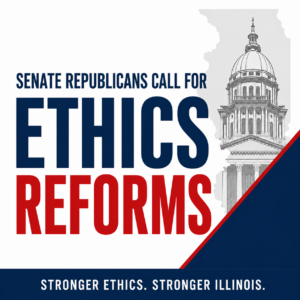 The release of the Legislative Inspector General’s report regarding former State Representative Harry Benton provides Illinoisans with greater transparency into a serious matter that has raised significant questions about ethics, accountability, and the handling of misconduct allegations within the General Assembly.
While making the report public is an important step, transparency alone is not enough. The release of the report should serve as the beginning of a broader conversation about strengthening ethics laws, improving accountability, and restoring public confidence in state government.
The report also underscores the importance of examining how allegations of misconduct are handled throughout the legislative process. Illinoisans deserve confidence that complaints are taken seriously, investigated promptly, and addressed without unnecessary delays.
For years, my Senate Republican colleagues and I have introduced legislation aimed at strengthening Illinois’ ethics laws, increasing transparency, and improving the independence of ethics investigations. Those proposals have included measures to empower the Legislative Inspector General, require greater disclosure of misconduct findings, strengthen protections for individuals who report wrongdoing, and close loopholes that have allowed ethics investigations to stall or remain hidden from public view.
Despite our repeated calls for reform following numerous public corruption scandals, the Democratic supermajority has consistently blocked or declined to advance many of those proposals, choosing instead to adopt more limited reforms that, in my opinion, fail to address the systemic weaknesses exposed time and again.
New Statewide School Cell Phone Policy Signed into Law
A new law recently signed into law will require Illinois public schools to adopt policies limiting student cell phone use during the school day while allowing local school districts flexibility in how those policies are implemented. I voted in favor of the bill.
Senate Bill 2427 requires every public school district and charter school to adopt a “bell-to-bell” wireless communication device policy beginning with the 2027-2028 school year.
The law generally prohibits students from using personal cell phones and other wireless communication devices during the instructional day, while providing exceptions for medical needs, Individualized Education Programs (IEPs), Section 504 plans, emergencies, and teacher-authorized educational activities.
Importantly, local school districts will retain the authority to develop policies that best fit the needs of their students and communities. Districts will determine how devices are securely stored during the school day and establish procedures for implementing the new requirements. The law also prohibits schools from suspending, expelling, or fining students solely for violating the cell phone policy.
I believe reducing classroom distractions will help improve student focus, increase engagement, and create a better learning environment.
August Events Taking Shape for District 33 Constituents
 August is here, and so are some new outreach events for those living in the 33rd District.
Up next on the calendar is an ICASH/Unclaimed Property Event that will be held this week on Tuesday, August 4 in South Elgin. Unclaimed assets include bank accounts, uncashed checks, funds from inheritances, insurance benefits, utility deposits, stock dividends, and more. Visitors can meet individually with a counselor from the Treasurer’s Office to search the database, learn about the claims process, and receive assistance filing claims. I hope to see a large turnout at this popular event.
Please mark your calendar now for these upcoming events:
- August 4: ICASH/Unclaimed Property Event in South Elgin
- August 19: Senior Fair in Carpentersville
- September 12: Document Shredding Event in Elgin
- September 15: Senior Fair in St. Charles
- October 14: Senior Fair in Crystal Lake
All of these events are listed on the Events page of my website with full details. Additional events are added regularly, so please visit my Events page regularly to learn about new events as they are added to the schedule.
House Speaker’s Call for Supplemental CPS Funding Ignites Debate Over Fairness
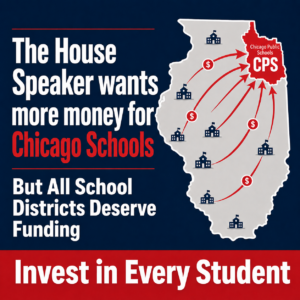 House Speaker Chris Welch recently pledged to lead an effort during the fall veto session to provide additional state funding for Chicago Public Schools (CPS), renewing debate over how Illinois should invest in public education. Speaking to the Chicago Teachers Union (CTU), the Speaker said he supports providing more revenue for CPS and committed to leading the effort for supplemental funding during the November veto session.
While additional investment in public education remains a priority, I maintain that any new funding should be distributed through Illinois’ Evidence-Based Funding (EBF) formula, the bipartisan system designed to allocate resources based on student need rather than political influence.
The Evidence-Based Funding formula was created to ensure school districts across Illinois receive state support in a fair and equitable manner. Hundreds of districts remain below full funding under the formula, and lawmakers estimate it would take billions of dollars to fully fund EBF statewide.
Rather than providing supplemental funding to a single district, I believe additional education dollars should strengthen the statewide formula so every underfunded school district has the opportunity to benefit.
I would also note that Chicago Public Schools already received special accommodations when the Evidence-Based Funding formula was adopted, including additional state support for the normal cost of teacher pensions. Existing provisions reinforce the importance of continuing to use the statewide formula rather than creating district-specific funding packages.
Federal Court Strikes Down Illinois Tuition Benefits for Undocumented Students
A federal district court recently struck down several Illinois laws that provided in-state tuition rates and financial assistance to noncitizens.
In United States v. Illinois, the federal government argued that Illinois law conflicted with a federal statute prohibiting states from offering residency-based higher education benefits to noncitizens unless the same benefits are made available to all U.S. citizens, regardless of where they live. On July 24, the court agreed, ruling that the state’s current in-state tuition provisions and portions of the Illinois DREAM Act and RISE Act violate federal law when applied to noncitizens.
The Illinois DREAM Act gives noncitizens access to scholarships, college savings, and prepaid tuition. Meanwhile, the RISE Act allows noncitizens to apply for state financial aid programs, including the State of Illinois Monetary Award Program (MAP.
The court permanently blocked the state from enforcing the affected provisions but delayed implementation of its order for 14 days, where in which Illinois can seek a stay while appealing the decision.
Grants Awarded to Support Local Food Infrastructure
The Illinois Department of Agriculture recently announced nearly $4 million in funding to strengthen and expand the state’s local food system.
The Local Food Infrastructure Grant Program provides funding to Illinois producers and food businesses to help improve the storage, processing, packaging, aggregation, and distribution of locally grown and produced food.
According to the IDOA, eligible applicants must be based in Illinois and involved in storing, processing, packaging, aggregating, or distributing value-added agricultural products. Eligible awardees include farms, cooperatives, processing facilities, food businesses and food hubs with 50 or fewer employees. Nonprofit organizations and units of local government may also apply.
The program was launched in 2025. Grants range from $1,000 to $250,000 for collaborative projects and from $1,000 to $75,000 for individual applicants.
For a complete list of 2026 grant recipients, click here.
Illinois State Fair Returns to Springfield
The 2026 Illinois State Fair kicks off Aug. 13 in Springfield with the annual Twilight Parade beginning at 5:30 p.m. The 11-day event features livestock shows, concerts, harness racing, carnival rides, fair food, and more.
This year, the Grandstand will host musical acts such as Lainey Wilson, Matchbox Twenty, Wiz Khalifa, and Ella Langley, along with several other performers. Numerous stages throughout the fairgrounds will also feature live music and other entertainment.
In addition to livestock and agricultural competitions, this year’s fair will feature a LEGO building contest, a pet photography contest, and a cheer and dance showcase.
The Illinois State Fair is hosting an admission tickets flash sale from August 1 through August 12, with fairgoers having the opportunity to purchase single day admission tickets for just $5 online during that time.
The 2026 Illinois State Fair wraps up Sunday, Aug. 23. More information is available on the Illinois State Fair website.